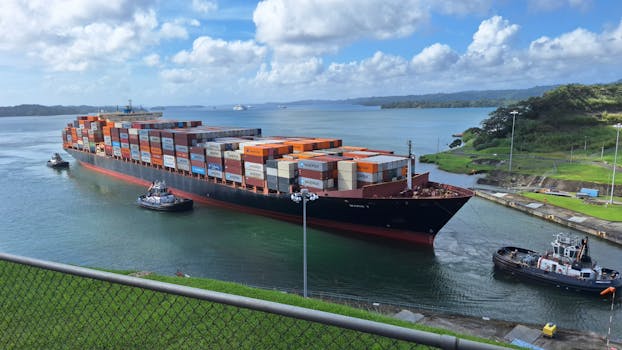
I'll be honest: I hadn't thought about the Panama Canal in years. It was one of those things you learn about in school and then forget exists until someone mentions it in a trivia game. But over the past few weeks, it's been all over the news, and for a scary reason. The canal is running out of water.
I'm not being dramatic. The Panama Canal relies on a system of locks that use fresh water from nearby lakes — primarily Lake Gatún — to raise and lower ships between the Atlantic and Pacific Oceans. Each ship that passes through uses about 50 million gallons of water. And right now, the lakes are at historically low levels because of a severe drought that's been going on for months. The canal authority has been forced to reduce the number of ships that can pass through each day, and the backlog is growing.
This isn't just a problem for Panama. It's a problem for the entire global economy, and it might already be affecting the price of things you buy. Let me explain.
How the Canal Actually Works (In Simple Terms)
The Panama Canal is a 50-mile waterway that connects the Atlantic Ocean to the Pacific Ocean. Before it opened in 1914, ships had to go all the way around the tip of South America — a journey that could take weeks and was dangerous. The canal cut that journey down to about 8-10 hours. It's a marvel of engineering, but it's also incredibly water-intensive.
The canal uses a lock system. Ships enter a lock chamber, the gates close, and water is either pumped in or drained out to raise or lower the ship to the next level. The water comes from Lake Gatún, which is fed by rainfall. And here's the problem: the region has been experiencing its worst drought in over 70 years. The lake levels are dropping, and the canal authority is rationing the water. They've reduced the daily transit capacity from about 36 ships to just 24. That means ships are waiting at the entrance, sometimes for days or even weeks.
The Domino Effect on Global Trade
About 5% of global maritime trade passes through the Panama Canal. That might not sound like a lot, but it's a huge volume of goods — primarily from Asia to the US East Coast, and from the US to Asia. We're talking about cars, electronics, grain, liquefied natural gas, and thousands of other products. When ships can't get through, they have to either wait or take the long way around South America. Both options are expensive.
Waiting costs money. Ships burn fuel just sitting at anchor. Crews need to be paid. Cargo gets delayed. And when cargo gets delayed, the cost of that delay gets passed down the supply chain — eventually to you. If you've noticed that prices for some imported goods have gone up recently, the canal drought might be one of the reasons. The Panama Canal Authority has also imposed surcharges on ships that use the canal, which adds to the cost.
The Climate Connection
This isn't just a random weather event. Scientists are increasingly linking the drought to climate change. The region has been getting less rainfall than average for several years in a row, and temperatures are rising, which increases evaporation from the lakes. The El Niño phenomenon has also played a role, disrupting normal weather patterns. If these trends continue, the canal could face periodic water shortages for decades to come.
There are proposals to fix the problem — building new reservoirs, desalination plants, or even piping in water from other rivers. But these solutions are expensive and would take years to implement. In the short term, the canal is just going to have to operate with less capacity. And that's going to keep putting pressure on global trade.
What This Means for You
You might not think about the Panama Canal when you're buying a new phone or a bag of coffee. But those goods probably traveled through the canal at some point. Delays and surcharges mean higher prices, or at least less predictable prices. You might not notice it in a single purchase, but over time, it adds up. The US East Coast is particularly dependent on the canal for goods from Asia. If the backlog gets worse, you could see empty shelves or longer shipping times for certain products.
The good news is that the canal authority is managing the situation as best they can. They're prioritizing ships that have booked slots in advance and reducing the maximum size of ships that can pass. But it's a Band-Aid on a bigger problem. The canal needs a long-term solution, and it's not clear where that solution will come from.
Is There Hope?
The Panama Canal Authority is exploring several options. One idea is to build a new reservoir on the Indio River, which would add a significant amount of water storage. Another is to use desalination to produce fresh water, though that's energy-intensive and expensive. There's also talk of improving water efficiency in the lock system itself. But all of these take time and money.
In the meantime, the rest of the shipping industry is looking at alternatives. Some companies are diverting ships to the Suez Canal, which doesn't have the same water issues. Others are investing in rail transport across Panama or Mexico to bypass the canal entirely. It's not an ideal solution, but it's a sign that the industry is adapting to the new reality.
I don't have a tidy conclusion here. The Panama Canal drought is a slow-motion crisis that's going to play out over years. It's a reminder that climate change affects everything — even the things we take for granted, like the ability to ship goods around the world. Next time you see a ship in a port, think about the journey it took to get there. And maybe appreciate the Panama Canal a little more. It's running out of water, and we're only starting to understand what that means.