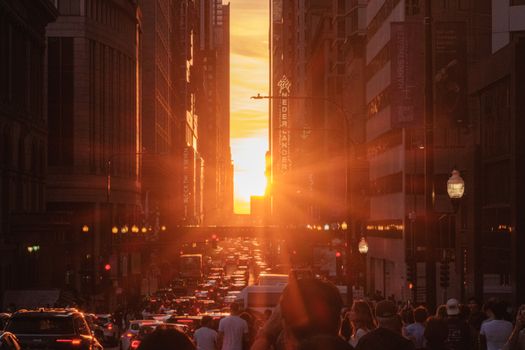
If you were on Instagram or Twitter (sorry, X) last week, you probably saw them: a series of photos of Manhattanhenge that looked almost impossibly perfect. The sun setting perfectly aligned with the street grid, the light streaming down the canyon of skyscrapers, the golden glow illuminating a crowd of thousands. The photos were shot by a photographer named James Chen, and they went viral almost instantly. The first one, posted on June 7, got 2 million likes in 24 hours. It was everywhere.
Then the controversy started. Some people accused Chen of using AI to generate the photos. Others said he manipulated the images in post-processing. A few claimed the whole thing was a marketing stunt for a new camera. I got curious and started digging. What I found is a story about photography, authenticity, and how we see the world in 2026.
What Is Manhattanhenge?
For the uninitiated: Manhattanhenge happens twice a year, around May 28 and July 13, when the setting sun aligns perfectly with Manhattan's east-west street grid. The effect is dramatic — the sun appears to set between the buildings, lighting up the streets with a golden glow. It's been a tourist attraction for years. Thousands of people gather at key intersections — 14th Street, 23rd Street, 34th Street, 42nd Street — to watch and take photos. It's a beautiful, chaotic, very New York event.
This year's May 28 Manhattanhenge was particularly clear. The weather was perfect — no clouds, no haze. Photographers were out in force. Chen, a 28-year-old photographer from Brooklyn, posted his series on June 7. The photos showed the sun perfectly framed between buildings, the light hitting the crowd in a way that looked almost supernatural. The colors were vibrant — deep oranges and purples. The composition was flawless.
Too flawless, some said.
The Accusations
The first accusation came from a photography forum called DPReview. A user named "PixelPeeper2026" posted a detailed analysis claiming that the photos had been heavily edited. They pointed out that the sun's position in Chen's photos didn't match the actual alignment on May 28 — it was slightly off. They also noted that the shadows didn't look right for the time of day. The colors, they argued, were too saturated to be real.
Then someone else noticed something weird: in one photo, a person in the crowd appeared twice — once in the foreground and once in the background, in a different position. That's a classic sign of AI generation or heavy compositing. The forum went into overdrive. Within hours, the accusations had spread to Twitter.
Chen responded quickly. On June 8, he posted a video on Instagram showing his raw files — the original images straight out of the camera. He explained that the photos were real, but he had used a technique called "focus stacking" and exposure blending to capture the dynamic range. The sun was so bright that a single exposure couldn't capture both the sun and the crowd. He merged multiple exposures. He also admitted to moving a few people in the crowd using Photoshop's content-aware fill — just to clean up distractions. "I removed a trash can and a guy on his phone," he said. "That's it."