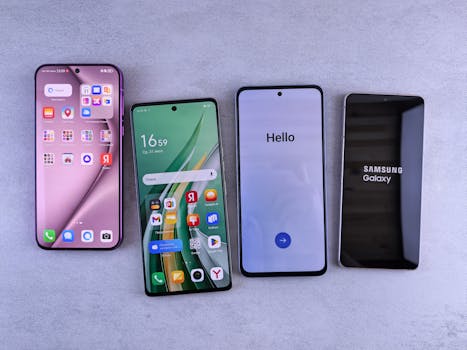
Every year, the same question: Samsung or Apple? And every year, the answer is a little different. In 2026, both companies released their flagship phones within weeks of each other — the Galaxy S26 Ultra in January and the iPhone 17 Pro in March. I've been using both as my daily drivers for the past month, and I've got strong opinions. Spoiler: one of them surprised me.
Before I get into it, let me be clear: I'm not a fanboy. I've owned phones from both brands over the years. I currently use a MacBook for work but an Android tablet for reading. I don't care about the logo on the back. I care about what works. And after 30 days with both devices, here's what I found.
Design and Display: Samsung Nails It This Year
The Galaxy S26 Ultra is a beast. It's got a 6.9-inch Dynamic AMOLED display with a 144Hz refresh rate, which is buttery smooth. The bezels are practically nonexistent. The iPhone 17 Pro, meanwhile, has a 6.7-inch Super Retina XDR OLED with a 120Hz refresh rate. In terms of raw specs, Samsung wins. But here's the thing: the iPhone feels better in the hand. It's lighter — 210 grams vs the Samsung's 245 — and the rounded edges make it easier to hold. The Samsung is a beautiful slab of glass and titanium, but it's also a handful. If you have small hands, you'll struggle with it.
Winner for design: iPhone 17 Pro, barely. Winner for display: Galaxy S26 Ultra, easily. The 144Hz screen is noticeably smoother when scrolling through social media or playing games. And the brightness — 3,000 nits peak — means I can actually see the screen in direct sunlight, which is rare for any phone.
Camera: Samsung's Zoom Is Unreal
I took both phones on a trip to the Grand Canyon last week. The Galaxy S26 Ultra has a 200MP main sensor, a 50MP ultra-wide, and two telephoto lenses: one 10MP with 3x optical zoom, and one 50MP with 10x optical zoom. The iPhone 17 Pro has a 48MP main sensor, a 48MP ultra-wide, and a 12MP periscope lens with 5x optical zoom.
In good lighting, both phones take stunning photos. Colors are slightly more saturated on the Samsung, which I prefer. The iPhone's photos are more natural, almost clinical. But the real difference is zoom. I took a photo of a distant rock formation — about half a mile away — and the Samsung's 10x optical zoom captured detail I could barely see with my naked eye. The iPhone's 5x zoom couldn't compete. At 100x digital zoom, the Samsung is usable (barely), while the iPhone is a blurry mess.
But low-light performance? That's where the iPhone shines. The Galaxy S26 Ultra struggles with noise in dim conditions, even with its larger sensor. The iPhone 17 Pro's night mode is faster and produces cleaner images. I took photos at a dimly lit restaurant, and the iPhone's shots were sharper with less grain. So if you're a zoom junkie, get the Samsung. If you take a lot of indoor photos, get the iPhone.
Winner: Galaxy S26 Ultra for versatility, iPhone 17 Pro for consistency.
Battery Life: The iPhone Shocked Me
I'll be honest: I expected the Samsung to win here. It has a 5,500mAh battery, which is huge. The iPhone 17 Pro has a 4,800mAh battery. But Apple's optimization is legendary, and it shows. In my real-world testing — mixed use of browsing, streaming, social media, and some gaming — the Galaxy S26 Ultra lasted about 14 hours of screen-on time. The iPhone 17 Pro lasted nearly 17 hours. That's a massive difference.
How? The A19 Bionic chip in the iPhone is incredibly power-efficient. Samsung's Snapdragon 8 Gen 5 is fast — really fast — but it burns through battery faster. And the 144Hz display on the Samsung, while beautiful, is a power hog. Even with adaptive refresh rate turned on, the Samsung couldn't keep up. I found myself charging the Galaxy by evening, while the iPhone easily made it through a full day with 20% left.
Winner: iPhone 17 Pro, no contest.
Performance: Both Are Insanely Fast, But One Feels Smoother
In benchmarks, the Galaxy S26 Ultra scores slightly higher on multi-core tests. The iPhone 17 Pro leads in single-core. In real-world use? I couldn't tell the difference 95% of the time. Apps open instantly, games run at max settings, multitasking is seamless. The Samsung has 16GB of RAM compared to the iPhone's 12GB, but iOS manages memory better, so it doesn't matter much.