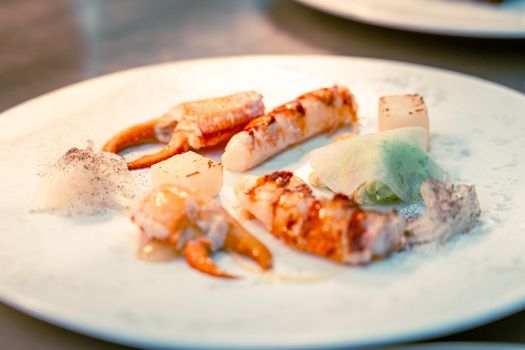
I love lobster. There's nothing quite like cracking open a steamed lobster tail, dipping it in melted butter, and savoring that sweet, briny meat. But I also know that the lobster industry is a mess. Overfishing, bycatch, and the environmental cost of transporting live lobsters across the country are real problems. A single lobster flown from Maine to California has a carbon footprint that would make a Prius owner cry.
So when I heard about 'Cellular Aquatics' — a biotech startup based in San Diego that's growing lobster meat from cells in a lab — I was intrigued. They've been working on this for five years, and last month, they got FDA approval to sell their product in restaurants. I managed to score a tasting session at a pop-up in Manhattan last Tuesday.
I went in skeptical. Lab-grown meat has been hyped for years, and most of it tastes like a sad approximation of the real thing. But the lobster? I was genuinely surprised.
How Do They Make Lobster in a Lab?
I sat down with Dr. Sarah Chen, Cellular Aquatics' head of research, before the tasting. She explained the process, and I'll try to simplify it without butchering the science.
They start with a small biopsy from a live lobster — a few cells, no harm to the animal. Those cells are placed in a nutrient-rich medium (a broth of amino acids, sugars, and vitamins) inside a bioreactor. The cells multiply, and over about three weeks, they form muscle tissue that's identical to wild lobster meat at the cellular level.
Here's the key difference from other lab-grown meats: they're not growing a whole lobster. They're growing specific cuts — tail meat, claw meat, knuckle meat. No shells, no guts, no waste. It's 100% edible meat, which is more efficient than traditional farming.
Dr. Chen told me that their process uses 90% less water and 80% less land than wild-caught lobster. The carbon footprint is about 70% lower. Those numbers are impressive, but I needed to taste it to believe it.
The pop-up was in a small kitchen in the East Village. The chef, Marco Reyes, prepared three dishes: a classic lobster roll, a lobster bisque, and a simple grilled tail with garlic butter.
The Taste Test: How Does It Compare?
I started with the lobster roll. The meat was shredded, mixed with a light mayo and celery, and stuffed into a toasted brioche bun. My first bite was... weird. The texture was spot on — tender, with that slight chewiness you expect from lobster. The flavor was also close, but there was something missing. A subtle brininess that wild lobster has, like a hint of the ocean.
Dr. Chen had warned me about this. 'We're still working on replicating the full flavor profile,' she said. 'The cell medium doesn't capture the marine environment perfectly.' She recommended adding a pinch of sea salt to the meat before serving. I tried that with the next bite, and it helped. Not perfect, but close.
The bisque was where the lab-grown lobster truly shined. The creamy, rich soup masked any minor flavor differences. The chunks of meat held their shape and added a nice texture. I couldn't tell the difference between this and a bisque made with wild lobster. Honestly, I'd order it again.
The grilled tail was the most revealing. A simple preparation — just salt, pepper, and butter — lets the meat speak for itself. The lab-grown tail had the same firm, flaky texture as wild lobster. The flavor was slightly milder, less 'lobstery,' but still good. With enough butter, I doubt most people would notice.
I asked Marco what he thought. 'It's 85% of the way there,' he said. 'For a first-generation product, that's remarkable. I'd serve it in a bisque or a salad without hesitation. For a whole grilled tail, I'd still prefer wild.'
The Price Problem
Here's the catch. The lab-grown lobster costs $45 per pound. Wild lobster is currently around $20 per pound in supermarkets. That's more than double the price.
Dr. Chen explained that the cost will come down as they scale up. 'We're producing about 500 pounds per month right now. Once we hit 10,000 pounds per month, we expect the price to drop to $25 per pound. In three years, we might be at $15 per pound.'
But for now, it's a premium product. The pop-up was charging $38 for the lobster roll, which is steep even by Manhattan standards. The bisque was $22 a bowl. I'm not sure the average person is willing to pay that much for a 'sustainable' alternative when the real thing is cheaper.