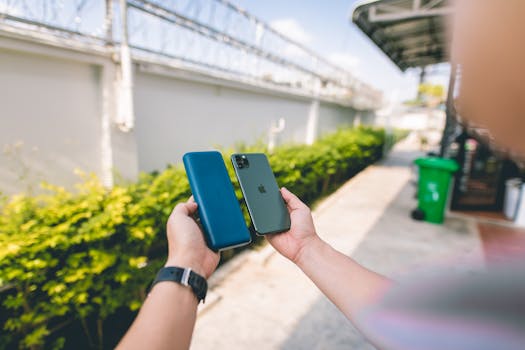
It's June 2026, and the smartphone wars are heating up again. Apple released the iPhone 17 Pro on June 5, and Google followed with the Pixel 11 Pro on June 8. I've been using both as my primary devices for two weeks, and I have a lot to say. Both are excellent phones, but they take very different approaches to what a smartphone should be. Here's my honest breakdown.
Design and Build: Apple Wins on Feel, Google Wins on Looks
The iPhone 17 Pro is a refinement of the iPhone 16 Pro. It has a titanium frame, a matte glass back, and a slightly larger 6.3-inch display. It's comfortable to hold, with rounded edges that don't dig into your palm. The Dynamic Island is still there, but it's smaller and less intrusive. The color options are muted — black, silver, and a new deep blue — which I appreciate.
The Pixel 11 Pro is more adventurous. Google went with a ceramic back and an aluminum frame, and the camera bar is now a horizontal strip that spans the entire width of the phone. It's distinctive — you'll never mistake it for an iPhone. The 6.4-inch display is slightly bigger, and the bezels are even thinner. But the phone is heavier, and the sharp edges make it less comfortable to hold for long periods.
Winner: iPhone 17 Pro. It's a better daily driver.
Display: Both Are Stunning, but Google Edges Ahead
The iPhone 17 Pro has a 6.3-inch OLED display with 120Hz ProMotion. It's bright, colorful, and smooth. Apple's color accuracy is legendary, and it shows here. HDR content looks incredible.
The Pixel 11 Pro has a 6.4-inch LTPO OLED display with a 144Hz refresh rate. It's even brighter — Google claims 3,000 nits peak brightness — and the 144Hz refresh rate makes scrolling feel buttery smooth. The colors are slightly more punchy than Apple's, which some people prefer. I found it a bit oversaturated, but that's a matter of taste.
Winner: Pixel 11 Pro. The higher refresh rate and peak brightness make a difference.
Performance: The A19 Chip Is a Beast
The iPhone 17 Pro is powered by Apple's new A19 Bionic chip, built on a 3nm process. It's fast. Insanely fast. Apps open instantly, games run at max settings without a stutter, and multitasking is seamless. The A19 also has a new Neural Engine that's 40% faster than the A18, which means AI tasks — like photo editing and voice recognition — are near-instant.
The Pixel 11 Pro uses Google's Tensor G5 chip, which is also impressive but not as fast as the A19. In benchmark tests, the A19 is about 20% faster in CPU tasks and 30% faster in GPU tasks. But here's the thing: the Tensor G5 is optimized for Google's AI features. It handles on-device machine learning tasks — like real-time translation and photo enhancement — better than the A19. For everyday use, you won't notice a difference. For power users, the iPhone is faster.
Winner: iPhone 17 Pro. Raw performance still matters.
Camera: Google Finally Caught Up (and Maybe Surpassed)
This is the biggest surprise. Google's Pixel phones have always had great cameras, but they lagged behind Apple in video quality. Not anymore. The Pixel 11 Pro has a new 50-megapixel main sensor, a 48-megapixel ultrawide, and a 64-megapixel telephoto with 5x optical zoom. The photos are stunning — detailed, well-exposed, with natural colors. Google's computational photography is still the best in the business, and it shows in low-light shots.