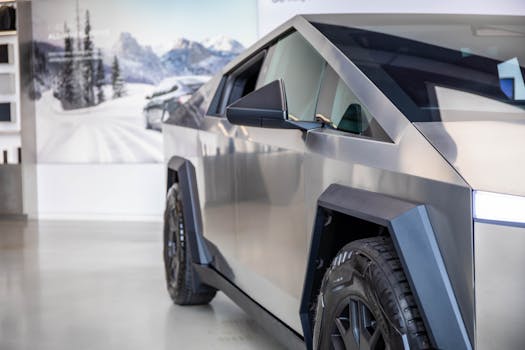
I've been following the Tesla Cybertruck story since Elon Musk first unveiled that weird, angular prototype back in 2019. Five years, countless delays, and one polarizing production launch later, I finally got my hands on one for a full week. I drove it around Los Angeles, took it on a road trip to San Diego, and even tried off-roading in the mountains near Idyllwild. Here's what I learned — the good, the bad, and the genuinely surprising.
First, let me address the elephant in the room: the Cybertruck looks bizarre. There's no other way to say it. The stainless steel body is angular and sharp, like a stealth fighter designed by a toddler with a ruler. People stare. They take photos. I had a guy in a Ford F-150 roll down his window at a stoplight and yell, "Is that the space truck?" It's a conversation starter, for sure. But does it actually work as a truck? Let's get into it.
The Interior Is Minimalist — Maybe Too Minimalist
Sliding into the Cybertruck's cabin feels like stepping into a futuristic waiting room. The dashboard is dominated by a single 18.5-inch touchscreen that controls everything: speed, navigation, climate control, even the side mirrors. There are no physical buttons for anything. That's a problem. Adjusting the air vents requires tapping through three menus. Changing the steering wheel position means digging into settings while you're driving. It's not just annoying — it's dangerous. I nearly rear-ended someone while trying to turn on the seat heaters.
That said, the seats are comfortable. Really comfortable. The vegan leather is soft, and there's plenty of headroom and legroom even for tall passengers. The panoramic glass roof lets in tons of light, and the cabin feels airy. Storage is decent — there's a cubby under the armrest and a front trunk (frunk) that fits a large suitcase. But the lack of storage cubbies for small items (like your phone or sunglasses) is frustrating. You basically have to throw everything into the center console.
Driving Experience: It's Like Nothing Else — and Not Always in a Good Way
The Cybertruck is massive. It's 231.7 inches long and 6.7 feet wide. Parking it in a standard spot is a nightmare. I had to back into spaces just to avoid sticking out too far. The turning radius is also surprisingly poor for a vehicle this size. Three-point turns become five-point turns. In tight parking lots, you'll feel like you're piloting a boat.
But once you get it on the open road, it's impressive. The tri-motor version I drove has 845 horsepower and does 0-60 in about 2.6 seconds. That's supercar territory. The acceleration is violent — it pins you to your seat and doesn't let go. The air suspension smooths out bumps, and the adaptive dampers keep body roll in check during corners. It's genuinely fun to drive fast, which feels ridiculous given that it weighs over 6,600 pounds.
Here's the weird part: the steering. Tesla uses a steer-by-wire system, meaning there's no mechanical connection between the steering wheel and the wheels. The ratio changes depending on speed. At low speeds, it's super quick — you barely have to turn the wheel to make a sharp turn. At high speeds, it slows down for stability. It takes a few days to get used to. I found myself overcorrecting on the highway at first because the steering felt too sensitive. By day five, I was used to it, but I'm not sure I'll ever love it.
The Bed: Actually Useful, With One Big Flaw
The Cybertruck's bed is 6 feet long and 4 feet wide — roughly the same as a standard short-bed pickup. It's covered by a hard, retractable tonneau cover that's motorized. That's great for security. You can throw tools or luggage in the back and lock it up. The bed also has power outlets (120V and 240V) and air compressors, which is handy for camping or worksites.
The problem is the tailgate. It's not a traditional drop-down tailgate. Instead, it's a ramp that folds down and extends, designed for loading ATVs or dirt bikes. That's cool in theory, but it means you can't sit on the tailgate like a normal truck. Also, the ramp is heavy and takes two hands to operate. If you're used to a standard truck, this will annoy you.