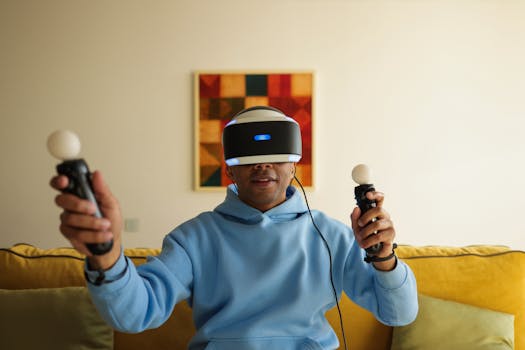
When Apple announced the Vision Pro in 2023, I was skeptical. A $3,500 headset that requires a tethered battery pack? It sounded like a prototype, not a product. But then I got my hands on one in early 2025 — a friend's unit that he'd bought on a whim and already regretted. He let me borrow it for a month. I wanted to hate it. I ended up conflicted.
Here's the unfiltered truth about living with Apple's spatial computer.
Day 1: Holy Crap, This Is Magic
The first time you put on the Vision Pro, it's genuinely shocking. The passthrough video is so clear that you forget you're wearing a headset. I could read text on my phone, see the texture of my carpet, and make eye contact with my cat. The eye tracking is unnervingly fast — you look at an app icon, pinch your fingers, and it opens. No lag. No drift. It just works.
I watched the first 20 minutes of Dune: Part Two on a virtual 100-foot screen hovering in my living room. The blacks were deep, the colors rich, and the spatial audio made it feel like I was in a theater. My jaw dropped. For the first hour, I was a believer.
Then the battery ran out. Two hours. That's it.
Week 1: The Honeymoon Fades
The Vision Pro's weight became a problem around day three. At 650 grams (without the battery pack, which is another 350 grams in your pocket), it's heavier than most VR headsets. The strap that comes in the box is fine for 30 minutes. After an hour, you feel it. After two hours, you're adjusting it constantly.
I bought the optional dual-loop band for $99. It helped, but not enough. The front-heavy design means the weight always presses into your cheeks. I developed a red mark on my nose bridge that lasted three days.
The field of view also bugged me. It's not terrible — about 110 degrees horizontal — but it's not immersive enough. You always have a slight tunnel vision effect, like you're looking through ski goggles. For watching movies, it's fine. For any kind of spatial computing, it feels restrictive.
The Apps: Great Potential, Terrible Execution
The Vision Pro has about 1,500 apps at launch. That sounds like a lot until you realize 90% of them are iPad apps ported over with no spatial adaptation. They appear as floating windows, just like on an iPad. That's fine for casual use, but it's not the revolution Apple promised.
The killer app is supposed to be spatial video — 3D videos shot with an iPhone 15 Pro or the Vision Pro itself. I watched a few home videos of a friend's kid blowing out birthday candles. The 3D effect was incredible. It felt like I was in the room. But the resolution is lower than normal video, and the content library is tiny. You can't just download spatial movies — there are maybe 20 available on Apple TV+.
Multitasking is where it shines. I had Safari, Slack, and Apple Music open as floating windows while sitting on my couch. It felt like having three monitors without the physical clutter. But the eye tracking, while fast, gets tiring. After 45 minutes of work, my eyes felt strained. I went back to my laptop.
The Social Experience: You Look Ridiculous
Apple tried to solve the isolation problem with EyeSight — a front-facing display that shows a digital version of your eyes to people nearby. In theory, it makes you less antisocial. In practice, it's creepy. The digital eyes look like a low-res avatar from a 2015 VR Chat. My roommate laughed every time she saw it.
Wearing the Vision Pro in public is also weird. I tried using it on a long train ride (my friend had warned me not to). People stared. One guy asked if I was "doing some kind of robot thing." The battery pack in my pocket made it awkward to sit. I gave up after 20 minutes.
This is not a device you use around other people. It's a solitary experience, and that limits how much you'll actually use it.
The Price: Let's Be Honest
$3,500 is a lot. For that money, you could buy a MacBook Air, an iPad Pro, and an iPhone — all of which do most of what the Vision Pro does, just without the spatial aspect. The accessories add up fast. The travel case is $199. The optional light seal cushions are $99. The battery pack replacement is $299. You're looking at $4,000 before you even start buying apps.
Is it worth it? For early adopters with money to burn, maybe. For the average person, absolutely not. This is a first-generation product, and it feels like one.
Where It Goes Next
I think the Vision Pro is a glimpse of a future that isn't here yet. The hardware is genuinely impressive — the micro-OLED displays, the M2+R1 chip combo, the spatial audio. But the software ecosystem isn't mature, the comfort isn't there, and the price is prohibitive.
If Apple releases a lighter, cheaper version with better battery life in 2027 or 2028, they might have a mainstream hit. For now, the Vision Pro is a developer kit sold to consumers. I'm glad I tried it. I'm even gladder I didn't buy it.