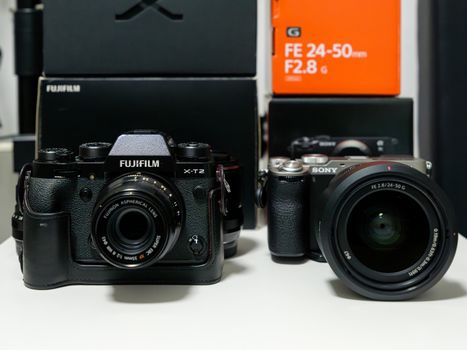
I've been a photographer for about 15 years now. Started with a Canon Rebel that I bought off Craigslist, then moved to a Sony A7 III, then got seduced by Fuji's film simulations. So when both Fuji and Sony released new cameras this spring—the X-T6 and the A7 VI—I knew I had to compare them. Not just on paper, but in real life. I spent a month shooting with both, carrying them everywhere from a rainy hike in Portland to a dimly lit wedding reception. And honestly? The winner isn't the one you'd expect from the spec sheets.
Let's start with what they are. The Fuji X-T6 is an APS-C camera with a 40-megapixel sensor, priced at $1,799 body-only. It's built like a tank—magnesium alloy, weather-sealed, with dials that make you feel like you're operating a film camera from the 70s. The Sony A7 VI is a full-frame camera with a 33-megapixel sensor, priced at $2,499 body-only. It's packed with tech: AI autofocus, 8K video, and a menu system that's finally usable. On paper, Sony wins. But in real life? It's more complicated.
Image Quality: Full Frame vs APS-C in 2026
Let's get the elephant out of the room. Yes, full-frame sensors generally have better dynamic range and low-light performance. The Sony A7 VI produces cleaner images at ISO 6400 than the Fuji at ISO 3200. But here's the thing—I had to pixel-peep to notice. In real-world shooting, the Fuji X-T6's 40-megapixel APS-C sensor is so good that the difference is subtle. The Fuji's color science is also miles ahead. Sony's colors have always looked a bit clinical to me—accurate, but boring. Fuji's film simulations, like Classic Negative and Velvia, give you gorgeous JPEGs straight out of camera. I shot a portrait of my friend under mixed lighting, and the Fuji shot looked like a magazine cover. The Sony shot looked like a medical diagram. That sounds harsh, but it's how I feel.
Autofocus: Sony's AI Magic vs Fuji's Reliability
Sony's autofocus is legendary, and the A7 VI takes it further. It has a new AI chip that can track human eyes, animal eyes, and even bird eyes. I tested it on a running dog, and it locked focus instantly. The Fuji X-T6 has improved autofocus too—it's faster than the X-T5—but it's not on Sony's level. In low light, the Sony hunts less and grabs focus more confidently. However, the Fuji is more predictable. The Sony sometimes gets confused between a person and a tree branch. The Fuji just works. It's not as smart, but it's more reliable. For a wedding photographer, I'd pick the Sony. For a travel photographer who shoots landscapes and street, I'd pick the Fuji.
Handling and Build: The Fun Factor
This is where the Fuji X-T6 destroys the Sony. The X-T6 has physical dials for ISO, shutter speed, and exposure compensation. You can change settings without looking at the screen. It feels like a real camera. The Sony has a mode dial and a bunch of customizable buttons, but you're always diving into menus. Even with the improved menu system, it's not as intuitive. Also, the Fuji is smaller and lighter. I carried it around Vancouver all day without fatigue. The Sony with a 24-70mm f/2.8 lens is a workout. The Fuji is also weather-sealed better—I shot in light rain with no issues. The Sony is weather-sealed too, but I was more nervous.