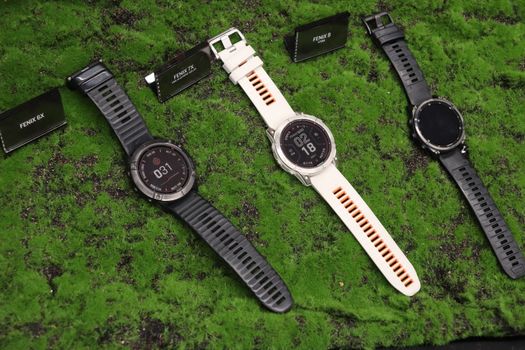
I'm a runner. Not an elite one — I do about 30 miles a week, a few races a year, and I like data. So when the Apple Watch Series 11 and Garmin Fenix 8 both launched this month, I knew I had to test them side by side. I wore the Apple Watch on my left wrist and the Garmin on my right for a full month. Yes, I looked ridiculous. No, I don't regret it.
Here's the thing: these watches are designed for different people. The Apple Watch Series 11 is a smartwatch that does fitness. The Garmin Fenix 8 is a fitness watch that does smart stuff. The question is which one fits your life. After 30 days of running, hiking, sleeping, and just living, I have a clear answer.
Let me start with the Apple Watch Series 11. It's gorgeous. The screen is always-on OLED, 2000 nits, and it looks like a miniature iPhone on your wrist. The new S11 chip is fast — apps open instantly, Siri is responsive, and the watch feels snappy. The design is the same as last year, which is fine because it was already great. It comes in aluminum, stainless steel, and now titanium (which Apple calls "Ultra light" but costs more). Battery life is officially 18 hours, but with the new power management, I got about 24 hours with moderate use. That's enough to track a workout, use it during the day, and wear it to sleep. But you'll charge it every morning.
Fitness tracking on the Apple Watch is excellent for casual athletes. The heart rate sensor is accurate — within 2-3 beats per minute of a chest strap during my runs. GPS is solid, though not as precise as Garmin's multi-band system. The new running metrics include ground contact time, vertical oscillation, and stride length. They're useful, but the presentation is less serious than Garmin's. Apple's Fitness+ integration is great for guided workouts, and the Activity rings are motivating (even if they're a bit gamified).
But here's the problem: for serious training, the Apple Watch falls short. The battery life means you can't do a multi-day hike without charging. The watch face isn't always visible during bright sunlight (even at 2000 nits, the Fenix is more legible). And the touchscreen is annoying when you're sweaty or wearing gloves. The Action button is a nice addition, but it only does one thing per app.
Now, the Garmin Fenix 8. This thing is a beast. It's thick, heavy (63 grams for the 47mm version), and looks like it belongs on a military commander's wrist. But it's also incredibly capable. The screen is a new AMOLED display (finally, Garmin ditched the MIP for some models), but you can also get the solar version if you want the classic transflective screen that's always visible. Battery life is absurd: 22 days in smartwatch mode, 58 hours in GPS mode, and 140 hours in expedition mode. I wore it for two weeks without charging and still had 40% left.
Fitness tracking on the Fenix 8 is next-level. The GPS is the most accurate I've ever used — it locks onto satellites instantly and tracks even in dense forests. The heart rate sensor is also improved, though still not as accurate as a chest strap during intervals. But the training metrics are where it shines. You get VO2 max estimates, training load, recovery time, training readiness, and even a "body battery" that tracks your energy levels throughout the day. The new Endurance Score tells you how well your body handles long efforts. I found it genuinely useful for planning my training week.